OLYMPIA – Following a decline at the end of 2024, the Washington Gray Wolf Conservation and Management Annual Report shows that the minimum year-end wolf count increased by more than 17% at the end of 2025. That puts the wolf population in Washington at its highest level to date, according to the report that was released today by the Washington Department of Fish and Wildlife (WDFW).
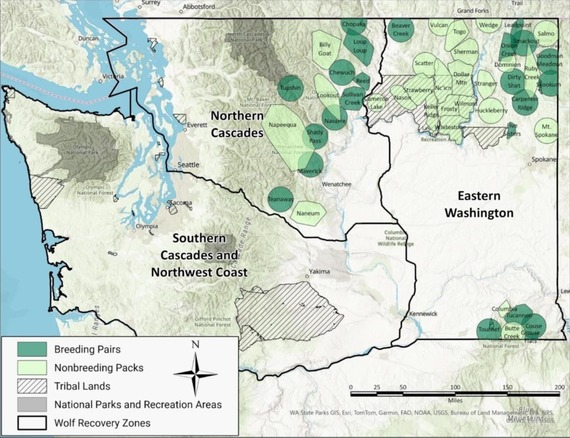
As of Dec. 31, 2025, WDFW and partnering tribes counted 270 wolves, 23 breeding pairs, and 49 packs across Washington. The previous year’s count was 230 wolves, 18 breeding pairs, and 43 packs. Pack sizes at the end of 2025 ranged from two to 12 wolves with most made up of three to seven individuals. Several packs either formed or reestablished in 2025.
“We confirmed six new or reestablished packs in the annual count,” said WDFW Wolf Biologist Trent Roussin. “Those that reestablished include the Salmo, Smackout, and Vulcan packs in northeast Washington. New packs include the Cameron Lake pack on the Confederated Tribes of the Colville Reservation and the Billy Goat and Tupshin packs in the North Cascades Recovery Region.”
No packs or breeding pairs were documented in the Southern Cascades and Northwest Coast Recovery Region at the end of 2025.
“This is despite collar data from a dispersing wolf and confirmed sightings of another indicating that at least two wolves had traveled through the area during the year,” said Roussin.
WDFW counts wolves annually through activities like track, aerial, and camera surveys. Survey results represent minimum counts of wolves associated with packs plus 12.5% for lone wolves and dispersers, due to the difficulty of counting every animal.
Fourteen collared wolves dispersed from their pack territories in 2025, representing 28% of the collared wolves monitored during the calendar year. Three collared
wolves (6%) dispersed out of Washington to Oregon, Idaho or British Columbia, Canada.
WDFW documented 28 wolf mortalities during 2025, including two killed while caught in the act of depredating on livestock, one unknown cause of death, two that died of natural causes, one related to WDFW capture and collaring work, 12 legally harvested by tribal hunters, three human caused mortalities on tribal ground, three mortalities from unlawful take, and four wolves lethally removed in response to wolf-livestock conflict.
WDFW documented 17 depredation events involving 19 cattle in 2025. Eight calves were confirmed killed by wolves while one was probably killed by wolves. Eight calves were confirmed injured by wolves, and two were probably injured by wolves. Five of the 49 (10%) existing packs in 2025 were involved in at least one confirmed or probable livestock injury or mortality. Three of those packs were involved in three or more depredations.
“That leaves 90% of known packs that were not involved in any known depredations in 2025 (including probable depredations) despite most pack territories overlapping livestock operations on both public and private lands,” said Roussin.
In addition to the Washington Gray Wolf Conservation and Management 2025 Annual Report, available on the Department’s website, a recording of today’s presentation of the report to the Fish and Wildlife Commission will be available on the website soon.
Contributors to WDFW’s annual wolf report include the U.S. Fish and Wildlife Service, the National Park Service, the Spokane Tribe of Indians, Swinomish Tribe, Yakama Nation, and the Confederated Tribes of the Colville Reservation.