

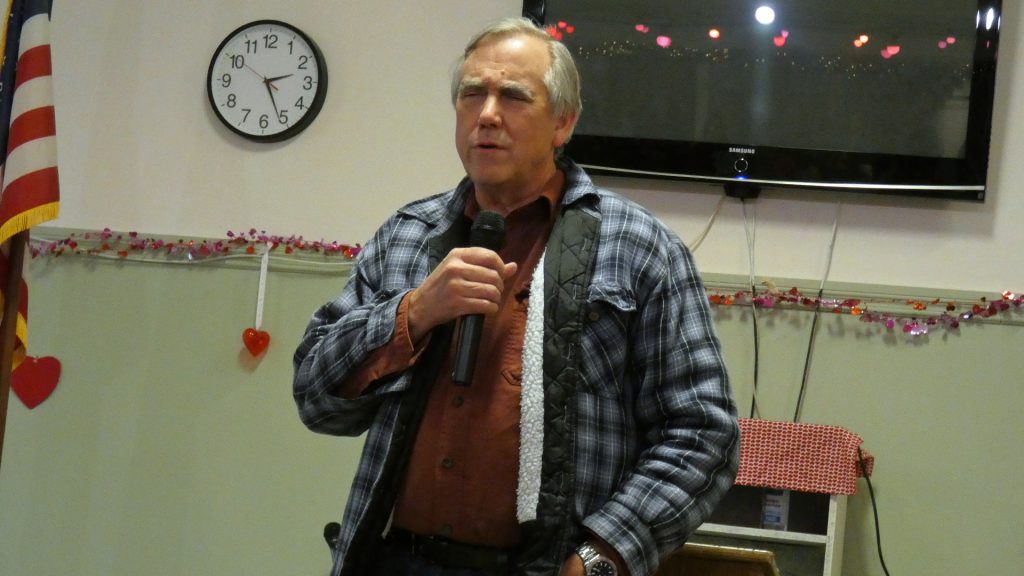
Story and Photo by Rodger Nichols for Gorge Country Media
We have an audio recording as well as the transcript, but we have to break it up in chunks because the whole hour runs 85 megabytes, and the program’s per entry limit is 8 megabytes. Transcripts are beneath each recording portion.
The county chair has agreed to mix up all of these tickets very equally so everybody gets a chance. Let me give me three of those at a time. I’ll read three of these numbers off these tickets and I’m just going to read the numbers on the far right. And so the last three numbers to the right in this case are 452 and 454 and 496. Just wave your hand. If you don’t see any hands, we’ll just keep rolling as quickly as possible. Okay. Okay.
Speaker 2:
Thank you. My name’s Robert Hegro and I just begun reading the book here, Senator. Second mountain by David Brooks. And he uses a phrase, the greatest legacy that one can leave or one of the greatest legacies that one can leave is immoral ecology. And that’s a pretty broad term, but I think we see in our country a display of immoral ecology. And I see standing at the podium now, an example of moral ecology. So I would just like you to comment on that generally and I want to thank you profusely from the bottom of my heart for all the efforts you put in the Senate in trying to resolve some of these many problems instead of creating new ones. Thank you.
Speaker 1:
We’ve seen every kind of norm shattered. And some of those are constitutional norms, including norm. I mean, it’s the fourth amendment that you can’t knock down people’s doors and grab them without a warrant. We’ve also seen kind of the conflict of interest norms violated in a way so massive we could never have envisioned it. A foreign company buying $2 billion, the president’s cryptocurrency, and then the United States deciding to making a decision at the same time to ship them a huge number of very, very sensitive microchips that were … Well, put it this way. They had been blocked for national security reasons before that $2 billion donation. And I must say, things just keep happening that you just got to go, ” Really? ” There’s all this thing with Jeff Bezos staying like $40 million for documentary rights when the highest bidder belong was 14 million or something like that.
It just almost feels like a direct cultivation of favor. That just didn’t exist before. So I would love for us to reestablish a culture in which government electeds were fully in it for the people and not for themselves. And that means we’re going to have to do a lot of reforms down the road. And one of those reforms, by the way, needs to be a code of conduct for the Supreme Court.
452 and 454, either one of those. Okay. We’ve got 585. 454
Speaker 3:
Here.
Speaker 1:
454. Okay, great.
Speaker 3:
Thank you, Senator. Thank you for being here. I think a lot of people are going to be asking some of the same questions I would have asked, but I want to bring up something different and congratulate you for shepherding childcare appropriations through the president’s desk. That’s going to be a lot to this community. You’ve been working on that for years. I believe it’s a two million dollar appropriation somewhere in that neighborhood. It’s key. Thank you for your work on that and seeing it through.
Thank you. And I think you’re referring to the Dalles Early Learning Center and it was 1.5 million, but hey, I’ll take two million. Do I hear 2.5 million? Renovating a former mill school to an early learning center. And one thing I’m very concerned about the turbulence we’re in now is that a lot of the gears of government are not turning on a timely basis or new conditions are added to grants or money’s caught back or money’s frozen or money’s impounded or you just can’t get an answer. And that really makes it hard for our local officials. That’s why I always like to start by having our local officials stand up and be recognized because when you run for office, there’s a certain number of issues and you figure you can tackle those, but then there’s all the things that after you’re elected that just are so tough. I mean, the easy things have already always been accomplished.
So everything that’s left is hard. And so anyway, I think there’s going to be a lot of ups and downs for a lot of grants, but every time we get a win, we need to pause and celebrate it. So thank you. Do we have four, five, two?
Okay. The next three are 585 and 508 and 512. Okay. Here and here. Okay, great.
Speaker 4:
585.
Speaker 5:
Thank you. Good afternoon, Senator Merkley. My name is Deb Allen, and the question I have probably seems slight in view of all the things that happen daily, but I’m very concerned about the funding for the National Park Service and the forest and DLM wild lands, which are being … They were already decimated, but not only the staff can’t do any maintenance, they’re rewriting the signs for the National Park Service. And I wonder, given the things that are happening to human beings, but is there anyone working on that particular issue to make sure that they are a crown jewel of the United States and we should be proud of them? Yes.
Speaker 1:
So I work very closely with Senator Murkowski of Alaska. She’s the chair of the interior spending, and I feel like the bill that we got past is pretty good, but it’s the execution of the bill that I’m really worried about. A lot of staff have been rift, reduction force, fired, if you will. And without the staff, things don’t get done. And there’s been a lot of transfers that means programs within the park service are supposed to be happening, aren’t happening. So we’re breathing deeply. We did put into the bill this year a lot of things that were report language that didn’t have the force of law. We put in the bill itself to try to create a little bit more accountability, but the strategy of the executive branch has been, ” Well, we can just ignore this and if you don’t like it, take us to court.” And the courts can’t move fast enough to respond to that.
And that’s where the norms are so important. I mean, it’s like, no, if the law lays something out, you know the difference between a Democratic Republic and authoritarian energy, Democratic Republic, representatives from all over get together and basically design the programs, decide how they’ll be funded, they authorize, they fund them. And in a strong man state, one person decides, and that’s the president, right? So we are striving to restore the vision of being a Democratic Republic and it comes down to things like the Park Service where I’m just immersed in it because of the serving on that particular committee. And when it comes to one piece of this was the proposal earlier this year to sell off huge amounts of our public lands. I’m like, ” Hell no.” Anybody want to go to their favorite camping spot and see a fence with barbed wire, Elon Musk, Al owns this.
So sorry, or Jeff Bezos. I mean, whoever the billionaires have are who have money. I mean, the legacy we’ve been passed down by our generations before us, we want to pass down to our children, grandchildren, and others. So we have twice beat back the whole, let’s sell off the public lands proposal, and every time it comes up, I think we’ll defeated, but the fact that it keeps coming up is a real concern. So thank you. And then I think, was it right up here? Absolutely. Okay. We’ll come to you next.
260206-140833 (Completed 02/08/26) Transcript by Rev.com
Page 2 of 12
This transcript was exported on Feb 08, 2026 – view latest version here.
Speaker 6:
Thank you. And first of all, I want to thank you for the survey regarding the survey regarding the social security. Thank you for panning that out, being interested in what we have to say on that. The other is kind of, I’m taking it personal for our local community, but it isn’t just our local community and that’s regarding the protection of water, land, and air with all the data centers that are happening and what’s happening there and how do we go forward with this?
Speaker 1:
Okay. The data centers don’t at this point have a strong federal connection in that they’ve primarily been regulated by state law. The main concerns I’ve been hearing are regarding the use of electricity and if that use of that electricity drives up the electric rates and the use of water and how water is impacted. And both those are very significant concerns that I think are going to get more and more attention. We’re entering a world where the combination of data storage, crypto mining and AI require these massive computing centers. I kind of wish just AI would go away, but it’s not going away and it’s a little scary though last week on the radio, they were talking about a new center where
different AIs talk to each other. Did you hear this? I’m like, ” That is spooky. That’s like you read about that in science fiction.” They were describing the conversations between this artificial intelligence and that artificial intelligence.
And I’m thinking like five years from now, they’re going to be discussing how to eliminate all of us completely. I mean, who knows? So we’re going to have to really wrestle with that. And one of the things I’m really concerned about is also the impact in terms of electricity consumption, where that power comes from, and whether that means a lot more carbon in the air and therefore a lot more climate impact. And so it really adds … I mean, a lot of the renewable energy we’re producing now is being offset by the higher consumption demands. So I think you had two … What was the other piece of your question?
Speaker 6:
Well, it’s just you actually talked about it, but it is our land because they’re taking up so much land. They’re rerouting water and then what’s happening in the air as well. I mean, it’s all connected. Nothing is-
Speaker 1:
All connected. That sums it up. Thank you. Okay. I think we’re right up here next.
Speaker 7:
So I also have a question about land use issues. I’m really concerned about national monuments, what’s going to happen in some of our national moments. I’ve heard that there’s a list of like 31 of them that I think a few of them as being expendable, perhaps to open them to mining or to oil gas leasing or just to get rid of them. And what can be done about that?
Speaker 1:
Okay. The question was about national monuments and can they be undone and opened up to mining and so forth. So just this morning I was talking with one of our senators about the area in the northern part of Minnesota where there’s a lot of called the boundary waters and a lot of people go there and go canoeing and so forth. And the reason why is that this very special area has protections, but this coming week there’s going to be a vote on taking away those protections. And the way that this is being done is there’s something called a Congressional Review Act, which was passed as a provision to address a rule within 60 days of being passed, that rule could be overturned by an affirmative vote of the House and the Senate. But the idea of a rule has now been expanded to any administrative action, including the designation of monuments or special areas.
260206-140833 (Completed 02/08/26) Transcript by Rev.com
Page 3 of 12
This transcript was exported on Feb 08, 2026 – view latest version here.
So it means every special area is subject to potential reversal. And there’s a supposed to be a 60 day restriction on this, but that 60 day restriction was based on how rules are notified in the congressional record, not on how administrative actions that were done for like sensitive places. So therefore the argument as well, since it wasn’t noticed in the same way a rule was noticed, we can reverse anything going any time back in time. And the first, this is, if you’ve ever heard of the term a nuclear option in the Senate, it means basically changing a rule simply by reinterpreting it to be something sometimes even completely different than the rule says. And there’s been three of those this year to expand the ability of the majority in the House and Senate to undo existing things. It started with a California clean air waiver.
There was a waiver. A waiver was never considered a rule. That waiver got undone. Oregon always attached itself to the California waiver, so it affected us here in our state, but lots of things have been opened up. I was very involved in the Cascade Siskiyou monument expansion and held community meetings, lots of turnout, lots of feedback for a really extraordinary part of our state. I don’t know what’s safe anymore in terms of any special protections. And I guess the best protection is having the votes to not undo these protections. I don’t know what will happen to the boundary waters we’re organizing. We’re hoping there will be bipartisan support to leave them in place, but I don’t know. It’s a short answer. 456, 582, and 497.
Speaker 8:
582.
Speaker 4:
Hi, my name is Michael Menzler. I do want to thank you for everything you’re doing to support the environment and democracy. I was recently very alarmed to read that ICE is planning to build 23 massive detention centers in warehouses.
My perception is that the brutality of ICE is deliberately calculated to provoke a violent backlash and that if they persist at it, that this will eventually happen and that will give the administration an excuse to invoke the Insurrection Act and start blocking those of us that they consider to be terrorists in these facilities. Do you have any control at the financial level at this point to do anything about this?
Speaker 1:
Well, there’s so much about ICE.
I’m just outraged by it. I was thinking back to a paper I wrote in college and I learned a lot about the secret police in Iran and they were called Sabak and just the word sounded like a scary organization and you’re notorious for showing up, nothing marked on them, knocking down doors, grabbing people, disappearing them. That’s happening in the United States of America right now. How many people are concerned that we almost have a secret police? I mean, who would imagine? Who would imagine that one part of Homeland Security would tell the other part of Homeland Security that you don’t need a judicial warrant to knock down somebody’s door. I mean, that’s just unbelievable and the violation of sensitive places, so many other pieces. So my belief is ICE has completely invalidated its legitimacy and that organization needs to be torn down to the studs.
So on the warehouses, there was a plant ice had to build a warehouse over in Newport, and I got very engaged in that. I had written a bill in 2014 that said they could not remove the helicopter and shut down that Coast Guard operation, and they ignored it. And guess what? It went to court and the court said, ” Wait, the law says you can’t undo that helicopter unless you do X, Y, and Z, all these things I’ve written, these conditions I’ve written in. ” And I’ve done that then to save the helicopter, the rescue helicopter on the coast, and I did it with Lindsey Graham of South Carolina because he had a helicopter that was in trouble. How did I ever anticipate that that would enable us to stop an ice operation? But here’s the but. Now we hear that they’re pursuing some type of environmental permit to build something over there and
260206-140833 (Completed 02/08/26) Transcript by Rev.com
Page 4 of 12
This transcript was exported on Feb 08, 2026 – view latest version here.
they’re saying ICE is saying, ” Well, we only stalled that operation until May 1st.” So we have one of these potentially here, and if not Newport, maybe in this county or maybe that county, I mean, who knows where.
And so funding is a possibility, but here’s the challenge. ICE got $75 billion in what Trump called his big beautiful bill and I call the big ugly betrayal. 75 built, that’s seven times the normal budget. So they have this money that is basically without any conditions on how they use it. It would take an act of Congress to claw that back. I do not think we’re going to have a majority to be able to claw it back or put control. We’re trying, in regard to ICE, I have written a number of bills. One of them is about basically ICE and CBP accountability that says that individuals can sue ICE for violation of civil rights. You can sue if your civil rights are violated by local or state officials, but not if they’re violated by federal officials, which is why the vice president proceeded to say that ICE has absolute immunity.
Well, I don’t think ICE should have absolute immunity in a democracy to violate our civil rights, and that’s why I wrote that.
Another is to get ice out of any possibility and sensitive locations that ranges from schools and places of worship, but it also includes polling places. And I’ve really been stressing my worry about polling places. And then Steve Bannon comes out two days ago and he said, ” We’re going to send ice in to surround polling places.” And we know he’s going to do that where he wants to suppress the vote, not to keep undocumented individuals from voting, because undocumented individuals do not vote, but to terrorize people because there’s men with guns walking up and down the line and you don’t want to get shot and that’s sort of intimidating. There is a federal law that says you can’t do that. So why worry?
Well, we’re worried because the president may declare an emergency and ignore the federal law. So I don’t know that we can stop the … They bought a lot of property, they bought a lot of warehouses already, but I think
as citizens react and say, ” We don’t want this here. We don’t want this style of operation.” I don’t know how much that impact, as long as Steve Miller is running the immigration operation, but I don’t think we’ll be able to shut down the funding they’ve already gotten, but maybe local land permits, those sorts of things may be more useful tools. Okay, we have 456 and 497. So then we’ll keep going.
Speaker 8:
This is 497. Hello, Senator. Thank you for being here. I think you have a hell of a tough job. Anybody want trade? No, no, no. And I support you and my other senator and everyone. And my question, you started to say that is about our voting. Our votes, I mean the mail-in votes, I know what this crazy president, and I don’t care who … If you don’t think he’s crazy, then whatever. Anyway, I don’t trust him, I don’t trust his yes man or his cop followers. And so I worry about the voting, about it being fair.
Speaker 1:
Okay, let’s talk about the voting. And I’m going to … Did all of you get a copy of this on the way in? Wonderful. So after my town halls last year, I went back and read the literature on how democracies are disappearing. And over the last 30 years, it’s rarely been by men with guns storming a Capitol or the equivalent of a White House. It’s been because they’ve been undone from the inside. And so as I read through those case studies, there were kind of 10 different strategies that authoritarians use. And so those are the 10 layout here. And I just wrote one page on each of them. Are these happening here? And the answer is yes, every single one of these strategies happening here, but the scariest of this list is number 10, that’s our elections, ones you just referred to. And so what’s going on?
There are a lot of things can be done to rig an election. We talked about like ICE going to the polling places to intimidate people, but the president is also trying to get a national voter database and so that names can be purged and they’d be purged in a biased manner. People vote the polls and they’re going to get to vote and then you wait. How come I’m not so registered? Oh, well, we purchased. Sorry. That’s happened in states, but he wants to do it nationally. Did you see the letter that Christie Nolan said to
260206-140833 (Completed 02/08/26) Transcript by Rev.com
Page 5 of 12
This transcript was exported on Feb 08, 2026 – view latest version here.
Minnesota? She said, ” We’ll get ice out of Minnesota if you give us your voter data list.” I’m very proud of our Secretary of State who said, ” Hell no.” And we fought the president court and we won.
But he also hates vote by mail. The president does. Why? Because you can’t manipulate it the way you can manipulate election day. On election day, you can move the precinct location, you can put out false information about it, you can move it where there’s no parking, you can have machines that don’t work or staff that don’t work, you can put intimidators on the line. So vote by mail has much more integrity than voting day, and that’s why the president hates it. So what did he do? Well, the shot across the ballot was we’re not going to postmark letters the day that they’re mailed anymore. We can overcome that. We used to require vote by mail, the ballot had to be received. So we’d say after Wednesday, Thursday at the latest, don’t mail it because you got to drop it off in a drop box so it’ll be received.
We could go back to that. We also, military ballots often come in late. We want them to make sure military ballots are counted and they’re not postmarked. And anyway, but that’s an example. Then there’s the essentially gerrymandering in which Texas kind of did the opening salvo, California responded, but there’s a Supreme Court decision coming up about gutting the remaining elements of the Voting Rights Act. If that happens, folks are saying that that could result in the mid decade gerrymandering of another 19 districts to move them from one party to the other party and that’s just results in a misrepresentation of the sentiment in America when districts are gerrymandered in that fashion. So there’s a lot going on with concern about the voting. I mean, what if the president says vote by mail, he said repeatedly it’s full of corruption. The opposite is true. It’s much more, has a lot more integrity than voting election day, but what if he says therefore the vote by mail ballots don’t count or whatever.
I mean, there’s no.
I am talking to our state officials about reinforcing our state laws about protection when we’re somewhat insulated by being vote by mail, unless vote by mail itself is attacked by the federal government. So it’s not something that we should be holding our breath on. It’s something that we have to be asking, what is being planned to undo the elections and how can we prevent it from happening and doing everything we can to protect the ballot box? 499 and 574 and 581.
Speaker 9:
574. 574. I’m just curious, most of the people in this room, we were just on the corner and the post office protesting our fearless leader. As a senator, I do appreciate everything you’re doing, like everybody says a tough job, but I’ve got this feeling that the legislation, senators, congressional leaders aren’t going to solve the problem. We seem to be fighting an uphill battle. We’ve got the other sides seem to control the three branches of government. Is it going to come down to something other than legislatures trying to get this country back? I mean, to me it’s …
Speaker 1:
So these were the 10 ways that democracies are undone, but the same literature says there are two things that can stop the undoing and one is mobilize citizens protesting in every possible way because then it becomes clear that the norms are being broken, the laws are being broken, the constitution being broken, and that it’s not acceptable. If there’s no protest, you’re really in trouble. And the second is the next election, because if you don’t have a fierce rebuttal of authoritarian strategies, by the time there’s another election two years later, too much time has passed and things are too great. And so that’s why the conversation has come back to elections. Now, when you talk about legislation isn’t going to get it done, I was thinking about the list of my legislation on really dice. ICEAT on my FACE Act. What’s that? Have you seen them going around and they hold their camera up to everybody in an audience and it’s like they’re opening your file cabinet because they can instantly, or your wallet, they can instantly get all this information about you.
It’s really an intimidation of peaceful protest. ICE and CBP Constitutional Accountability Act, that is the The ability to sue for your civil rights being violated. Restrain access for detainees or restore access for
260206-140833 (Completed 02/08/26) Transcript by Rev.com
Page 6 of 12
This transcript was exported on Feb 08, 2026 – view latest version here.
detainees. That’s about the ability to get contact with attorney after you’re detained. Protect Sensitive Locations Act. It’s to keep ice out of the sensitive locations, including polling places. The preventing authoritarian policy tactic. That’s about ending the secret police strategies. But can I get any of those passed? No. Now right now we’re in this negotiation and the negotiation is over Department of Lawland Security and we put out a list of 10 items and they’re essentially embedded in those types of things that I just talked about. I do not think we’re going to get agreement with the majority party on that list. I don’t think we’re going to get agreement on maybe any of them.
Well, we still have some leverage except the leverage is limited because ICE has been prefunded for years to come to that 75 billion. So I don’t have the votes to pass these bills now, but there might be the votes in January of a year out to pass those bills and that’s what I’m hoping will be possible.
Speaker 10:
456.
Welcome to Wasco County Senator. So I’m a prior law enforcement person. And my concern is this. I don’t really understand. I think one of the biggest firewalls that we have in all of our communities is our local law enforcement, sticking with our humane approach to the way we treat people and the way we do things. And also empowering them to feel that they have the strength to push back when they see illegal or unlawful behavior by other people, just as if you were to see somebody assaulting somebody as a law enforcement officer, you feel like you have the responsibility to act. We need to show that we have that backbone within our communities, because that’s the only way we can feel safe and we can also feel like we have some sort of pushback. My question to you is, and this is I’m switching a bit, is this.
How do you, and I imagine myself walking the halls,
working with colleagues, and hearing the backside of what they’re saying, and then seeing their behavior in public. And how do you work with that and understand? And my question is, do you see some periods of light within some of these folks who express themselves so horrifically in times in public? Are you seeing some regression and some sort of backsliding that they can say, ” Yes, this is really wrong and we really need to change
Speaker 1:
Things.” Not as much light as I hope. I do see colleagues who are not running for reelection because they’re uncomfortable with the direction of things. And when they’ve spoken up, they’ve taken a meeting, but I guess I’ll just put it that way, not as much light as I would hope. You have seen some moments. For example, we had in the house, what was the house voted on? There was something they voted on. There were 17 house votes on something the president didn’t want and 17 Republicans crossed the aisle. I can’t remember what it was now. Epstein. Epstein.
Epstein. Okay. But I mean, literally partisan about holding powerful people accountable for grooming and abusing and raping young women. And by the way- Children. Children. Children. Boys and girls. Yeah. Boys and girls. Children. I carried the Epstein bill in the Senate. I put it up as an amendment and it was tabled. And then because of the discharge petition process, it was put up for a vote in the house and it passed with all but one vote. So here’s something overwhelmingly, when people had to vote on it, they were willing to say, ” No, this should never happen. Disclose those files, hold people accountable, have transparency, get some sort of … ” Well, it’s not really justice after, I mean, so long after the fact, but some sort of attempted justice for the victims. And yet, so when it came to the Senate, I went to the floor with the minority leader and we asked for unanimous consent that when the bill arrives, so it takes a couple days, it’d be deemed to pass and send to the president.
We got 100% support. All right. So this last week we went to the floor again with a proposal that says here are putting some teeth in that creates a penalties for the administration if they don’t release all the paperwork and it was objected to by the majority party. And I gave a little tirade on the floor like, ” How can a hundred senators say this is really important, but then when you try to hold the president’s team
260206-140833 (Completed 02/08/26) Transcript by Rev.com
Page 7 of 12
This transcript was exported on Feb 08, 2026 – view latest version here.
accountable to actually release all the files, you say no.” Anyway, by the way, there’s a second set of Epstein files that Senator Widen is leading on treasury files,
And those involve suspicious activity reports, a billion and a half dollars. You have dates, you have names, you have amounts of money. That’s an investigator’s treasure trove. And so we’re trying to find a way to put some real momentum behind Epstein 2.0. I mean, all this is separate from authoritarian takeover, but this really is about, is there anything close to equal justice under law? The very first political act I was involved in was in high school when this is all ancient history for all young folks out there, but we had a vice president who took $100,000 in bribes, spiraling. And so I’m reading the paper when I’m in high school, and that was back when we had two papers. We had the morning paper and an afternoon paper. And my dad’s a mechanic, got the afternoon paper, read her evening paper, and it said, ” Hey, the court gave him a penalty.
What was the penalty? $10,000 fine.” I’m like, wait, wait, if you’re rich and powerful, you take $100,000 and the penalty is just $10,000. So I wrote a letter to the Oregon Journal and they published it and that was my first … Because I think that the vision of equal justice under law means something. And we are so far away from that now. We’re not even close to it. And I’d sure like to see us be in a very different place a few years from now, equal justice under law. Let’s not just have it a vision. Let’s make it a reality. And the last two of those were 499 and 581. 499.
Speaker 11:
Senator Merkley, I feel like in my heart that you’re a man who seeks truth because of the Epstein Act, my name is Lana Jack. And I’m the last of my. Our sacred grounds right here, our sacred waters right here. I’ve been gifted to find out the truth because they’ve lied on us as the Salilah Yan people all these years and Congress, people like yourself who sat in your seats, condoned to these things, condoned to our mama’s being stolen, raped, sent to concentration camps, all of the topics we’re on. I’m not even an Indian as I stand before you. This city, this county, and this state by Constitution says I don’t even have the right to be here. It’s an all white state constitution. And as the last of my people, I’m going to tell you, everything you guys are going through is what we’ve been experiencing all this whole time.
I’m tired now. I need help. I need help. I don’t think I’m going to live through everything that’s been cut. You guys haven’t even felt the wrath the way our people have. Everything’s been cut for us.
We are the Columbia River Indians and we’re still here living on the streets. We don’t even have a home in our own homeland. Unfulfilled promises. We were supposed to be federally recognized and have the right to govern ourselves here and have the say over our sacred site. Salilo Falls was the most sacred. Nobody protested that. Where were you when we were being done away with? Systematically. Write up a new law to get rid of us. Public law 280 allowed this town to do away with us. This little Indian’s going to go to prison. This one’s going to go to war. This one’s going to go to boarding school.
This town has never been friendly to us. And even as Google paid this town $109 million and the 12 nonprofit or non-taxables get their share, we’re still a nobody. Come out to our Indian villages. We relive in extreme poverty and been subject to extreme poverty all this time. I stand up here shaking because I know how much hate I have experienced in this town my whole life. And there’s no help, but I got the truth. Trump was trying to sell the Seattle National Archives. I’d just gotten done having a stroke. How could I do 14, 15, 16 hour days pulling documents? I thought I knew something, but when I got these documents, the truth of how this town, county and state did away with us because they wanted Salila
He was the equivalent to me in my heart a Teddy. A Teddy Roosevelt. He walked in that much greatness with the magnitude to share his heart and claim justice for anybody who knew injustice, who stands for justice. I hear it. Deserves the full promises in exchange for the flooding of the falls, not denial, not rejection, not ridicule, no more hate.
260206-140833 (Completed 02/08/26) Transcript by Rev.com
Page 8 of 12
This transcript was exported on Feb 08, 2026 – view latest version here.
Speaker 12:
I really appreciate you sharing passionately from your heart and life experience, and really there’s a lot to be accounted for over the history of our society. So Senator Hatfield was my first playful mentor. He worked to get a lot of the tribes restored to federal recognition, but it’s very hard to undo injustices of the past equivalent to restore them to the level that the original injustice happened. And tremendous number of people really hurt in the process. So thank you. I think we had … Did we have someone else?
Speaker 6:
581. Thank you.
Speaker 13:
Hi, Senator Merkley. My name is Sylvia Crompton and I’m a resident of Rolena Oregon and fires driver. I know Rowana was devastated by the wildfire here in June. My entire neighborhood is gone. Many residents had preexisting septic systems that were fully functional and not damaged by the fire. However, the county is requiring full replacement or upgrades to current code before residents can rebuild. Most lots in Rollina are too small to meet today’s setback and leach field requirements, and the replacement systems are upwards of $25,000 each. Many victims were uninsured or underinsured, so this requirement makes rebuilding or even selling their properties financially impossible. This is now the single largest barrier preventing wildfire recovery in my community. I understand that it’s a county regulation, but wildfire recovery intersects with state and federal disaster frameworks. We’re asking whether your office can help convene or encourage flexibility so regulatory barriers don’t prevent oral disaster recovery without disrelief.
We are effectively displaced lower income rural residents who survive the fire but can’t afford regulatory compliance. And we use your office’s influence to work with the county and the relevant state agencies to allow undamaged preexisting septic systems to be grandfathered in as a part of wildfire recovery efforts.
Speaker 1:
So just to repeat a little of what you said, make sure I understood. You say that the $25,000 system was a fire suppression system?
Speaker 13:
No. These are septic tanks on individual lots in Rowena. Most of the lots in Rowena are a quarter to a third of an acre. The current code requires much more space for leach fields, et cetera, and we are being required to bring these systems up to code before we’re allowed to build. My family was lucky we are able to do that, but many of my neighbors are not going to be able to, and it will also be a roadblock for them to even sell their properties to people who could afford to rebuild.
Speaker 1:
Yeah.
Speaker 13:
Just because it’s not big enough. These systems were grandfathered in in the first place and they are not covered by insurance regardless of the disaster.
Speaker 1:
Yeah. Okay. Got it. And was that a city code or that’s a county code? It’s a county
260206-140833 (Completed 02/08/26) Transcript by Rev.com
Page 9 of 12
This transcript was exported on Feb 08, 2026 – view latest version here.
Speaker 13:
Code, I believe.
Speaker 1:
Well, listen, I’m happy to follow up and convene a discussion. I know that county and local officials always love a US senator suggesting that we brainstorm over something, but most of the time they’re like, ” Okay, yeah, let’s talk about it. ” Because maybe there’s a federal element to it. One federal element that came out of the fire was folks said, ” Hey, we couldn’t get FEMA support because we didn’t have the collective total.” So I’ve introduced a bill that is basically a Fire Recovery Act is the name of it to help communities devastated by fire like Rowena. That isn’t going to address the immediate problem you’re raising, but I’m certainly happy to convene a conversation with … Can we convene local groups now? Yeah.
Speaker 13:
We have formed a nonprofit Village of Rowena Inc. It has been brought together by survivors in order to get a seat at the table because we are eight months out of it and these are the hurdles that we’re dealing with
and we’re not seeing that money from the United Way. We’re not seeing things that are going to help us. We are seeing things that will help people in the future that are in our situation, but nothing that is immediate for these Romina survivors.
Speaker 1:
Okay. Point taken. Happy to convene the conversation. Rebecca. Thanks. Okay. So we’re running out of time. We have 516, 500 and 586. 506. Right here. 506 we do not …
Speaker 6:
Sorry. 516.
Speaker 14:
Well, just to wrap things up, I gave your heart to be here in the whole election issue. Post office. I was just at the post office and talk to someone about it and he said, ” Well, maybe the state should be ready to send their national guards to protect the votes.”
Speaker 1:
Well, listen, that’s not an absurd idea because look, the federal law says that federal agents cannot be, and military cannot be allocated to sensitive, to polling places, right? And so the question I raised with several of our state leaders is given that the federal government may ignore the federal law, maybe we need state law to be able to give the same protections so that we have a second strategy to be able to go to court. But then also in my mind, if there are … I mean, we don’t really do it by polling place, so we don’t have to worry as much about the intimidators, but around the country, if we need folks to make sure that there’s not that sort of intimidation occurring with the lines do exist, others may need to go out and provide protection. I mean, I hope none of that’s necessary.
I mean, this is just … Hopefully it won’t come to that, but we need to look at every possible idea to protect the sacredness of our
Speaker 14:
Elections. And I also wanted to mention that 20 years from now, it will be a Hispanic person speaking up like a Native American person spoke up and said, ” What could happen to my
260206-140833 (Completed 02/08/26) Transcript by Rev.com
Page 10 of 12
This transcript was exported on Feb 08, 2026 – view latest version here.
Speaker 1:
Family? ” Point taken. And I did read two other numbers. I know we’re out of time, but I’ll try to be very quick in quick question, quick answer. 500. 500.
Speaker 15:
I was about right’s daughter too. What? Closer. Let’s end with, I was going to ask you a question, but after she spoke and all that’s going on in the nation, I just feel like my heart is on the floor. So can you give us some words of encouragement? I mean, I’m really worried about what ISIS going to do to our kids. I mean, St. Mary’s is just across the street here, the school, and we have a big Spanish population here. I’m worried about the little kids. I don’t know what we can do about that. Maybe you can help us figure something out, but you want to wrap it up with something that we can be hopeful about because I wake up in the middle of the night and can’t sleep worried about our nation.
Speaker 1:
So what gives me some encouragement is looking to history because we’ve gone through some very dark times and certainly the Great Depression is a very dark time. The Civil War is a very dark time. And those were things internal to America. So I’m not talking about foreign wars and so forth, but people came together, they figured a way out of it, and that is what we have to do again. And if those that came before us could find a path out of a very dark place, then we can find a path out of a very dark place.
It is however so important that everybody be engaged. That’s why I appreciate the hall being pulled. People have said, ” Well, what can I do? ” I said, ” Well, first, you can’t sit on a couch, lay on a couch with a pillow over your head and hope it gets better, that doesn’t work.” And the second is you can fiercely hold your electeds accountable, let them know through your phone calls, through your letters, through your public protests that these things matter too.
And third, join an affinity group for whatever cause you touches your heart because to be frustrated and angry alone is to be depressed. But to be frustrated and angry and organized with others is to be energized and effective.
And based on the turnout town halls and what I’m seeing in my mail and so forth, I think it gives me a lot of hope and I see you got to know King’s t-shirt on. How many people want to know King’s March? The third one. The third one. Okay. Every week. So that’s what gives me hope is seeing the current passion of that people are disturbed with what’s going on and knowing that when people are disturbed and they get organized, we can find a path forward. I’m going to close with a little bit of different note and that is many folks have said, ” Well, I feel like the dark clouds are high and I just feel the stress of what the nation’s going through and so I’ve got a suggestion. Take a few days, turn off your cell phone, turn off the news, and hit the road around Oregon.” And to help with that, I put together this pamphlet, Oregon Treasures Quest, which has cool places in all 36 of our counties.
Did you all get this on the way in? Yeah. You page through here and you go with your families, your friends, and you take a few days and you’ll discover things that some of you know about but haven’t visited before, some you wouldn’t know about, haven’t known about. And if you go to 10 counties and you proceed to send us a selfie of something in here, if you’re invited to the annual Treasure Quest party, we’ll have our third annual before Thanksgiving. And here’s the thing, no matter how difficult everything is nationally or internationally, we still have one incredible gift, which is we live in the best paradise to be found anywhere on planet earth right here in Oregon. So anything can help us resorre. Listen, thank you all so much. I know the county chair has a few announcements for you. I’ll see you all down the road and let’s save our Republic.
Speaker 16:
All right. Thank you
260206-140833 (Completed 02/08/26) Transcript by Rev.com
Page 11 of 12
This transcript was exported on Feb 08, 2026 – view latest version here.
Speaker 17:
So much. We clearly appreciate you being here. I just wanted to, everybody that’s here obviously wants to be engaged. So I’m sure you all know, but the short session in Oregon is underway, started on Monday. So there’s a lot of activity down in Salem. So a lot of things you should probably be engaged in and keeping aware of. I wanted to give a quick Rowena fire update. So there were some comments back there about the challenges. Certainly there has been challenges. It’s taken much, much longer than we ever imagined, but there is some good things happening out there. About half of the burned homes that wanted to get cleaned up have already been cleaned up. We think the cleanup, which is being funded by the state, undertaken by the county, is going to be done by the end of February. And if you drive out there, I was out there a couple of weeks ago.
There are already some homes that have been replaced, some new manufacturer homes that have been replaced. And while we have a long, long ways to go, there has been some really good progress. I also wanted to remind you that fire season is upon us, even though it seems like it’s not. It’s February. It will be here before we know it. And fire season is important. A lot of people don’t have the resources to deal with fire fuels and stuff, but Mid Clubbing and Fire Rescue has a program to help you out if you need that. And then the county got a $6 million grant from the federal government for community wildfire grant in the south part of the county, which can also help you. And then the final thing I wanted to say, which is I wanted to give you some caution when analyzing issues.
So a lot of times we all look at our sources of information and we read something on social media and we think that that is true. A lot of times stuff that you see online is not always true. So I would encourage you to go beyond just reading something and figuring out it’s fact. And there’s a lot of elected officials here. I’m one of them. If you have a question and you’re frustrated about something, come and talk to us, call us, send us an email. That’s why we exist, that’s why we’re here, and at least you can talk to us because a lot of times we see stuff online that says, those guys are bums and they’re doing this. And it’s like, where did they get that from? We’re not … We may be bums, but we may have some other information for you. So I would encourage you to use us.
I see a city councilor in the back there, so we’re here to serve you and that’s why we’re here. We’re trying to do the best job we can. So again, thanks for coming and have a great day.
260206-140833 (Completed 02/08/26) Transcript by Rev.com