
In 1999, the Oregon Legislature passed HB 2977, Mandatory Boater Education, requiring operators of motorboats with engines greater than 10 horsepower and youth 12-15 years of age operating any size motorboat, to take a course on basic boating skill and/or pass an equivalency exam to demonstrate basic boating knowledge. The primary reason for passing the law was to reduce accidents, injuries, deaths, property damage, and conflict on Oregon’s waterways. Oregon was the first state west of the Mississippi to enact an education requirement. Today, there are more than 45 states and U.S. territories that require some form of boating safety education.
Back in 1999, the Oregon Legislature gave the agency three years to implement the program, first offering a home-study and mail-in application option between 2000 and 2003. Then in 2003, the age phase-in began and ended in 2009, when all boaters, regardless of age, had to meet the education requirement.
From the beginning, the Marine Board wanted to have plenty of options for boating safety education by offering internet, in-person classroom, and equivalency exams for boaters to choose from. When the age phase-in began in 2003, there were three approved Internet course providers. The Marine Board also partnered with the U.S. Coast Guard Auxiliary, US Power Squadrons (America’s Boating Club), and the Red Cross to offer classroom courses around the state. Additionally, the agency developed its own volunteer instructor program with certified instructors teaching the “Boat Oregon” classroom course. The third option available for boaters included equivalency exams, offered through certified Boat Oregon instructors or county Sheriff’s Offices with approved marine patrol proctors. The three options remain today, and approved internet courses have expanded, including courses in Spanish. Virtual classes are also offered throughout the year in partnership with the U.S. Coast Guard Auxiliary.
Of note, when the law was passed in 1999, the accident reporting threshold was set at $500. In 2001, the threshold was increased to $2,000 to reduce the number of reports for minor damage and to align with changes in the cost of boat repairs. This reporting change is evident in a significant drop (in the chart below) in 2001. What’s more, the data below for accidents (incidents) and fatalities includes non-motorized boaters per reporting requirements for the U.S. Coast Guard. Since 2010, paddling in Oregon and across the nation has shown exponential growth. Motorized boating incidents and fatalities have been declining on average over the last 15 years.
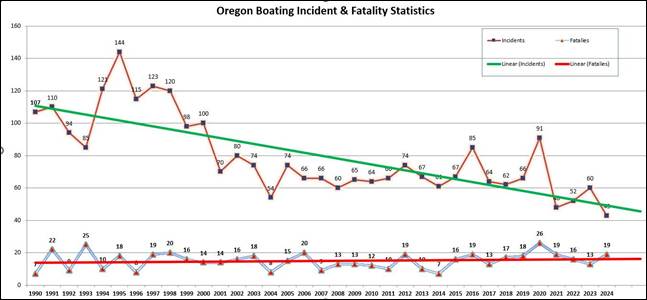
The inference can be made based on submitted boating incident reports, indicating whether the boat operator did not have a boating safety education card.
Very little has changed in the Marine Board’s administrative rules for the program in reference to ORS 830.082 for the Mandatory Boating Safety Education Program. The program has been self-supporting through boating education card fees with very little agency administration and does not rely on other funding. In the past 25 years, the price of the lifetime card increased once, from $10 in 2000 to $20 in 2020. Replacement cards increased from $8 in 2000 to $16 in 2020. The increase was due to other rising costs in US mail postage, other supplies, and the card printing itself.
Course options remain the same, although approved internet courses have modernized, giving the student an interactive learning experience. Oregon-specific course content and testing are routinely updated to remain relevant to current national standards or changes in state boating laws. The agency now offers a digital Boat Oregon classroom course manual, also available in Vietnamese, Simple Chinese, Russian, and Spanish.
With the popularity and growth in paddling, the agency encourages people who recreate in kayaks, canoes, rafts, and stand up paddleboards to take advantage of FREE online paddling safety courses. They’re fun, interactive, and outline not only Oregon state boating laws, but also other important tips to reduce accidents out on the water.
Currently, over 439,700 education cards have been issued, and Oregon’s boating safety education program continues to be a model for other states and territories.
The BEC is a lifetime card and must be carried by the operator when the boat is in use. The BEC must be shown to a marine law enforcement officer upon request.
Visit Boat.Oregon.gov to learn more about all things recreational boating.