
At last Thursday’s Chamber of Commerce Community Affairs podcast Q-Life Executive Director Liz Lance made a big announcement:
“Fiber broadband is coming to The Dalles,” she said, “and this is the biggest change in Q-Life’s history and The Dalles history. There is not an existing fiber provider for residential service in The Dalles. What this means is, if your Internet ever buffers a little bit, or you can tell when there’s a sports game on because you can’t connect to a Zoom call, those are the problems we’re going to solve for our community, because we need to be in this digital age and consume as much as we want, to be able to move our economy forward.”
Fiber optic provides blazing Internet speeds up to 10 gigabytes, a mere 100 times faster than is available locally.The federal government defines broadband as a minimum of 100 megabytes a second download and 20 megabytes a second upload. While the podcast was on, one of the members ran a speed test on his Spectrum service and came up with 90 megabytes download and 10 megabytes upload. By contrast, fiber optic cable service is symmetrical, meaning download and upload speeds are the same.
Ms. Lance said there would be tiers of service, with the minimum likely to be in the 300 megabyte to 1 gigabyte range. The exact tiers and their prices have not yet been finalized, but that information should be ready by mid-September, with actual connections coming in the last three months of the year.
Where are they going to start? Here are two maps.
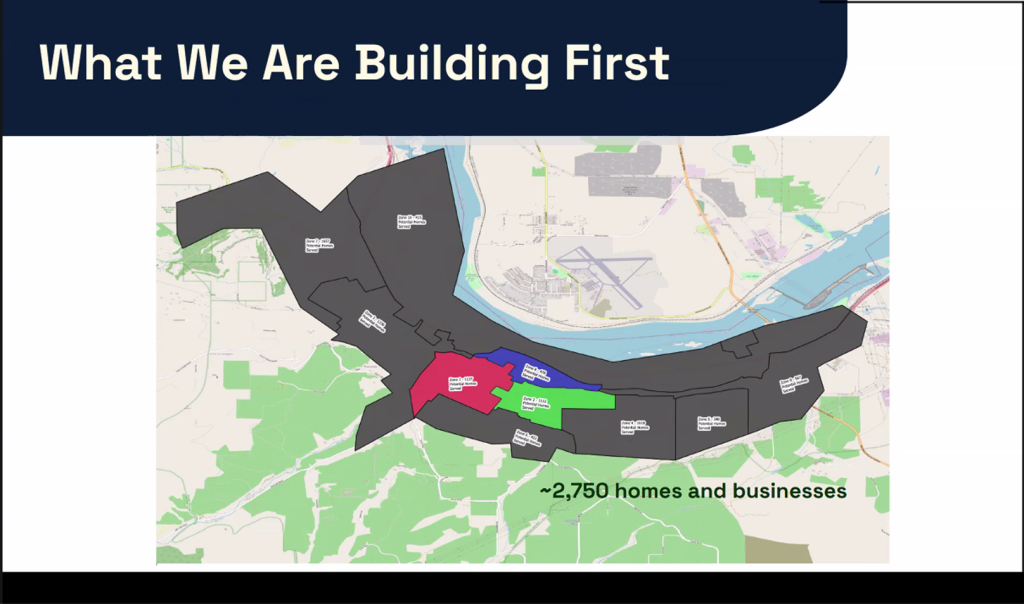
The first shows the three zones where the fiber optic cable will first be installed, with the rest of the zones in black. That map is fairly low resolution, but the second map below is a bit more detailed and shows all the zones in color. We’ve outlined in red the three contiguous zones – 1,2 and 8.
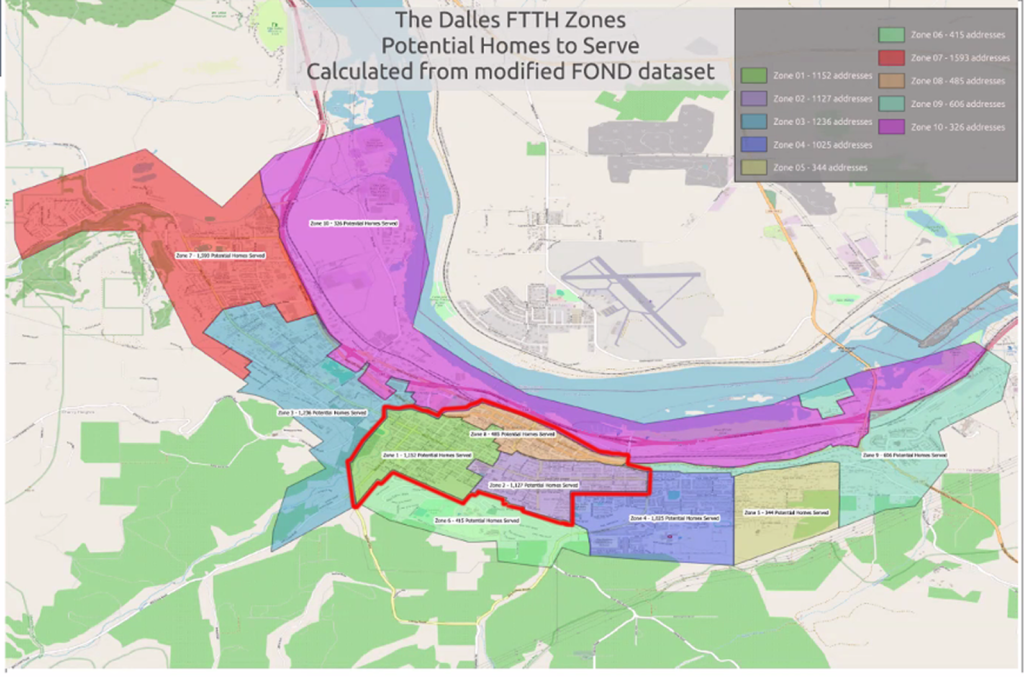
FTTH on the map above stands for Fiber To The Home, and FOND stands for Fiber Optic Network Design.
Ms. Lance said that if anyone can get together a group in the a different neighborhood who want to sign up, that can be a priority to work in that area. And she wanted you to know one last thing for sure:
“It is really important to know that Q-Life is not funded by any taxes,” she said, “There’s no assessments, no taxes that fund Q-Life. Q-Life is solely funded historically by debt and also by voluntary subscription revenues, so Q-Life will develop as far and wide as we can possibly afford.”